
Quick answer
Website monitoring helps prevent SEO traffic loss by detecting technical issues, page changes, crawl problems, indexation risks, SERP movement, competitor activity, and site health problems before they grow into ranking or traffic drops.
For SEOMER, monitoring is not only uptime checking. It is a connected workflow that watches the website from several angles: crawler signals, Google Search Console data, SERP monitoring, indexation checks, competitor changes, alerts, logs, uptime, and reports. Together, these signals help teams keep a constant pulse on the site and react before small problems become expensive losses.
- SEO monitoring surfaces critical errors, risky changes, and visibility drops early.
- Competitor monitoring helps teams see what others changed and improve their own pages.
- Crawler, indexation, GSC, SERP, uptime, and log signals create a fuller picture of website health.
- Alerts help teams respond faster instead of discovering problems after traffic has already dropped.
Why website monitoring matters for SEO
SEO traffic rarely disappears for no reason. In most cases, the signs appear earlier: an important page changes, a template breaks, a section becomes harder to crawl, a group of pages starts returning errors, or competitors improve pages that used to be weaker than yours.
If the team sees those signals early, the problem can usually be fixed before it becomes a serious visibility loss. If nobody sees them, the first warning may be a traffic drop in analytics or a delayed decline inside Google Search Console.
This is why website monitoring is more than a technical feature. For SEO teams, owners, agencies, and team leads, it becomes a protection layer around organic visibility.
SEO impact
The earlier a team detects broken pages, crawl errors, indexation changes, or ranking movement, the easier it is to protect traffic. Monitoring turns SEO from delayed reporting into active control.
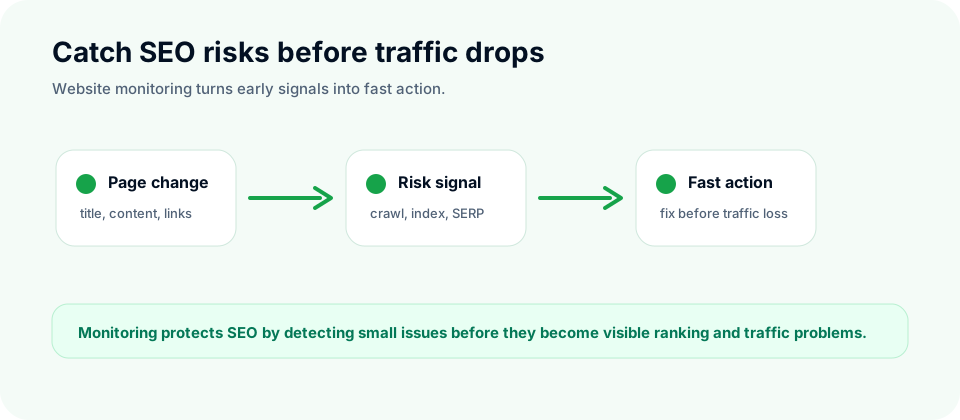
How SEO traffic loss usually starts
Traffic loss often begins quietly. Someone changes a title. A content block disappears. A page starts loading slower. A redirect chain appears after deployment. A canonical tag points to the wrong URL. Googlebot starts receiving more errors. A competitor updates a landing page and wins a better result in the SERP.
None of these events looks dramatic alone. But together they can reduce crawl quality, weaken relevance, lower rankings, and make a site less attractive to Google, AI crawlers, and users.
Good monitoring helps answer practical questions:
- What changed on the site?
- Which pages were affected?
- Did crawlability or indexation change?
- Did SERP positions move?
- Did GSC metrics react later?
- Did competitors change something important?
- Does the team need to act now?
Common mistake
Many teams check SEO only after traffic drops. The stronger workflow is to monitor the signals that usually appear before the drop: page changes, errors, crawl behavior, indexation, and SERP movement.
The signals SEOMER connects
Website monitoring works best when signals are connected. A single metric can be misleading. A ranking drop may come from a competitor update, a page change, a crawl issue, a technical error, or a change in search intent.
SEOMER brings these signals into one workflow:
- Crawler data shows page structure, status codes, metadata, links, and technical SEO issues.
- Indexation monitoring shows whether important pages are visible to Google.
- Google Search Console shows delayed search performance: clicks, impressions, CTR, and queries.
- SERP monitoring shows how positions move in search results.
- Uptime monitoring detects availability problems before they damage crawlability or trust.
- Log monitoring reveals Googlebot, AI bot, user, fake bot, and server-side activity.
- Reports turn findings into clear explanations and next actions.
The point is not to collect more dashboards. The point is to understand the relationship between signals. When a page changes, the crawler detects it. When Google reacts, GSC eventually shows it. When rankings move, SERP monitoring confirms it. When logs show bot behavior, the team can understand whether crawlers are actually reaching the right pages.

Competitor monitoring turns observation into advantage
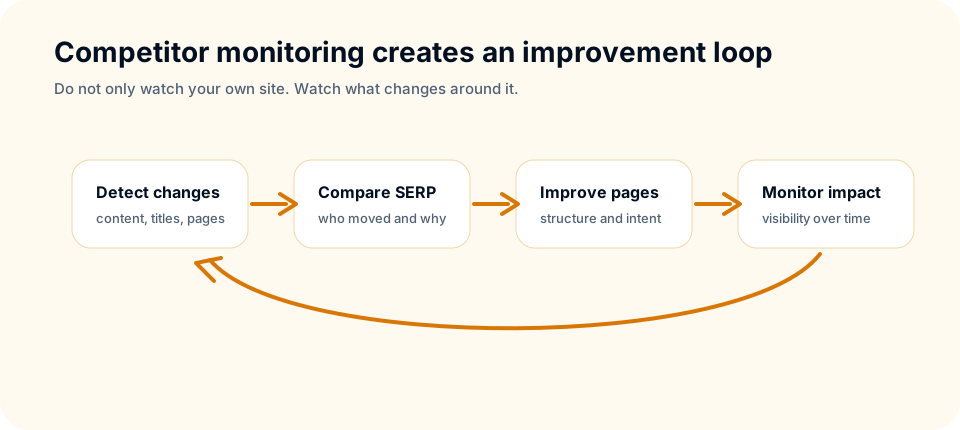
SEO monitoring should not look only inward. Competitors change pages, publish new content, adjust titles, expand sections, improve internal links, and target queries that may overlap with yours.
When competitor activity is monitored, teams can react with more context. If another site improves a page and your ranking drops soon after, that is a very different situation from a purely technical issue on your own site.
SEOMER can support competitor analysis through the crawler, SERP movement, and historical signals such as web archive checks. This helps teams see not only where competitors are now, but what they changed over time.
The practical benefit is simple: you can improve pages with evidence. Instead of guessing why a competitor moved higher, you can look at structure, content depth, title changes, topic coverage, and search result movement.
SEOMER tip
Competitor monitoring is most useful when combined with your own page changes and SERP tracking. The question is not only “who ranks higher?” but “what changed before they moved?”
Making the site clearer for Google and AI bots
A healthy website is easier for both Googlebot and modern AI crawlers to understand. That does not mean adding artificial signals. It means keeping the site technically clean, accessible, well-structured, and consistent.
Monitoring helps with this because it keeps the team aware of the details that bots rely on:
- important pages return correct status codes;
- metadata stays relevant and stable;
- content changes are tracked;
- crawl paths remain clear;
- indexable pages do not disappear by accident;
- server errors and downtime are detected quickly;
- logs show whether Googlebot and AI bots actually visit important URLs.
When these signals are monitored together, the site becomes easier to control. Teams can see whether the technical foundation supports SEO visibility or quietly works against it.
Alerts and fast reaction
Monitoring is only useful if the team can react. That is why alerts matter.
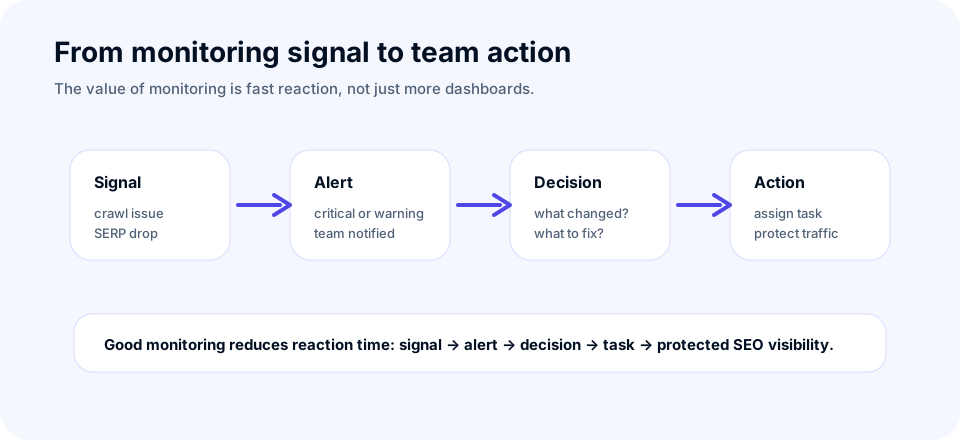
SEOMER can help teams receive notifications when critical changes or risks appear: downtime, server errors, important page changes, suspicious log patterns, visibility drops, indexation issues, or other events that need attention.
The goal is not to create noise. The goal is to notify the right people when something actually matters.
For an owner, this means fewer surprises. For a team lead, it means faster task assignment. For an SEO specialist, it means less manual checking and more time spent fixing the right problems.
Operational impact
Good alerts reduce reaction time. Instead of discovering a technical issue days later, the team can review it while it is still small.
A practical monitoring workflow
A strong SEO monitoring workflow looks like this:
- crawler checks detect technical changes and page-level problems;
- uptime and logs detect availability, server, bot, and security signals;
- indexation monitoring confirms whether important pages remain visible;
- SERP monitoring tracks position movement in real search results;
- GSC data confirms delayed search performance trends;
- competitor monitoring explains market movement;
- alerts notify the team when action is needed;
- reports summarize what happened and what to do next.
This creates a practical control loop. The team does not wait for traffic to disappear. It watches the signals that usually explain traffic movement before the final drop becomes obvious.
Best practices for preventing SEO traffic loss
Start with the pages that matter most: landing pages, revenue pages, category pages, product pages, and pages that already bring search traffic. Monitoring everything is useful, but prioritizing critical URLs helps teams react faster.
Track changes, not only errors. A page can be technically available but still lose performance if its title, description, content, internal links, or indexation state changes badly.
Compare multiple signals before making decisions. A GSC decline should be checked against SERP movement, crawler findings, indexation status, logs, uptime incidents, and competitor changes.
Finally, use reports to turn monitoring into action. A good report should not only say that something changed. It should explain why it matters and what the team should check next.
For a complete structure, continue with the SEO monitoring guide.
For teams building a complete workflow, the SEO monitoring guide connects website monitoring with alerts, GSC data, logs and technical SEO signals.
For large websites, crawl budget analysis connects website monitoring with crawl depth, server health and Googlebot behavior.
Conclusion
Website monitoring helps prevent SEO traffic loss because it keeps teams close to the signals that matter: technical health, page changes, crawlability, indexation, SERP movement, GSC trends, logs, uptime, competitors, alerts, and reports.
When these signals are disconnected, teams react late. When they are connected, teams can see problems earlier, understand causes faster, and fix the right things before traffic loss grows.
SEOMER brings those signals into one monitoring workflow so owners, team leads, SEO teams, and agencies can keep their sites healthier, more understandable for Google and AI bots, and more stable in search results.